A bank may tell you that you are eligible for a loan.
That answers the lender’s question.
But your family has a different one:
Can this loan fit into our financial life without making everything else more difficult?
Suppose a family earns ₹2 lakh per month.
After existing EMIs, household expenses, children’s costs and other regular commitments, ₹45,000 remains.
Now suppose they are considering a new loan with a monthly EMI of ₹25,000.
Mathematically, it fits.
After the EMI, ₹20,000 is still left.
But that ₹20,000 may need to do several other jobs.
It may need to build an emergency reserve.
Fund long-term goals.
Support parents.
Absorb an unexpected expense.
Or help the family manage a temporary disruption in income.
So if you are asking “how much EMI can I afford?”, the answer should not begin and end with loan eligibility.
Loan eligibility answers the lender’s question. Affordability answers the family’s question.
Start with what remains after the EMI
Borrowers often look at income first and ask:
“How large an EMI can this salary support?”
A more useful approach is to work backwards:
“How much financial flexibility do I want to preserve after paying the EMI?”
In our example:
Monthly surplus before new loan: ₹45,000
New EMI: ₹25,000
Surplus after EMI: ₹20,000
The loan may still be affordable.
But the real question is whether ₹20,000 is enough for the household’s other priorities and uncertainties.
If almost every rupee of free cash flow is committed to fixed repayments, the household may remain technically solvent while becoming financially fragile.
The EMI gets paid.
But emergency savings stop growing.
Investments towards goals are reduced.
Unexpected expenses are pushed onto credit cards.
A job change becomes harder.
That is why the most important number may not be the EMI itself.
It may be the surplus that remains after the EMI.
Will the new EMI weaken your financial resilience?
A loan that feels comfortable in a normal month may feel very different during an income disruption.
Before taking a major loan, ask:
What happens if income stops for three or six months?
Would your emergency reserve comfortably support household expenses and EMIs?
Or would you need to liquidate investments, borrow from family or use expensive short-term credit?
This matters even more when:
- one person provides most of the household income;
- income is variable;
- existing EMIs are already meaningful;
- emergency savings are limited; or
- major family responsibilities are approaching.
The higher your fixed monthly commitments, the less room there is for life to go differently from plan.
Don’t let the EMI quietly replace your goals
One of the easiest borrowing mistakes to miss is this:
The EMI fits only because something else gets reduced.
Suppose the family can afford the new ₹25,000 EMI only by cutting retirement investments or reducing the amount being set aside for children’s education.
The loan has not become cheaper.
Another financial goal is effectively funding it.
This is particularly important for long-tenure loans.
A small monthly compromise repeated over many years can materially affect long-term goals.
Before taking the loan, ask:
Can I continue making reasonable progress towards the goals that matter even after this EMI begins?
If the answer is no, the loan may be affordable in cash-flow terms but expensive in financial-planning terms.
The hidden cost of a loan is often reduced flexibility
Some costs never appear in the loan calculator.
Consider what a long-term EMI may do to your ability to:
change jobs;
take a career break;
start a business;
move to another city;
support parents;
increase investments;
or handle a major unexpected expense.
This does not mean loans are bad.
Borrowing can help families purchase homes, fund useful assets and meet important life objectives.
But every fixed financial commitment reduces some degree of future flexibility.
That trade-off deserves to be understood before the loan begins.
A better answer to “How much EMI can I afford?”
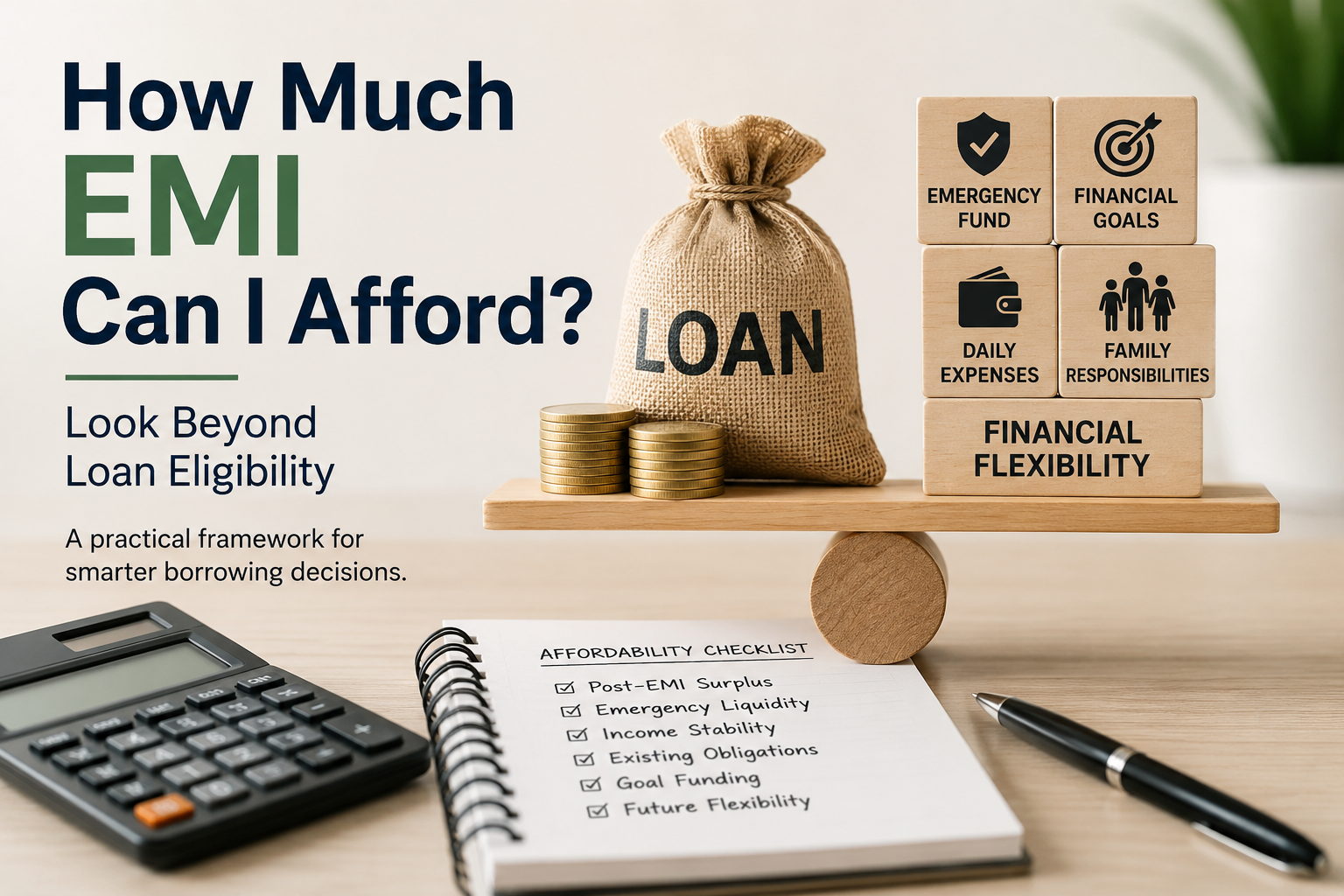
Before committing to a new loan, run this five-question test.
1. What will remain after the EMI?
Do not calculate affordability from income alone.
Calculate the post-EMI monthly surplus.
2. Is my emergency liquidity adequate?
Could the family manage expenses and EMIs through a temporary income disruption?
3. Can I continue funding important goals?
The loan should not quietly replace retirement, education or other important priorities.
4. How much debt am I already carrying?
A new EMI must be assessed alongside existing loans, credit-card balances and other fixed commitments.
5. What flexibility am I giving up?
Consider not only today’s affordability, but also the choices the loan may restrict over the next several years.
These questions will usually tell you more about real affordability than a lender’s eligibility number alone.
The EMI is only one part of the decision
There is no single EMI-to-income percentage that works equally well for every household.
Two families earning exactly the same amount may have very different borrowing capacity.
One may have:
strong emergency reserves,
stable dual incomes,
low existing debt,
and well-funded goals.
The other may have:
a single income,
multiple EMIs,
limited savings,
and significant family responsibilities.
Their incomes may be identical.
Their true ability to take another loan is not.
That is why the question “how much EMI can I afford?” needs to be answered in the context of the entire financial life.
Not just income.
Not just eligibility.
And not just this month’s payment.
Because every financial decision competes with another priority.
Sometimes the most important number in a loan decision is not the EMI.
It is what remains after the EMI.

Which financial priorities deserve attention right now?
A loan is not an isolated decision.
Cash flow, debt, emergency reserves, goals, protection, family responsibilities and future flexibility all interact.
Explore your Life Stage Priority Canvas at:
lsfr.millionsworth.com
Life Happens. Are You Prepared?
Millionsworth Financial Services | AMFI Registered Mutual Fund Distributor | ARN-171940
This article is intended for financial education and general information. Borrowing decisions should be evaluated in the context of individual income, liabilities, liquidity, goals and circumstances.