Why US inflation, India’s CPI and the oil market need to be read together
Crude oil and inflation in India are becoming increasingly important to read together.
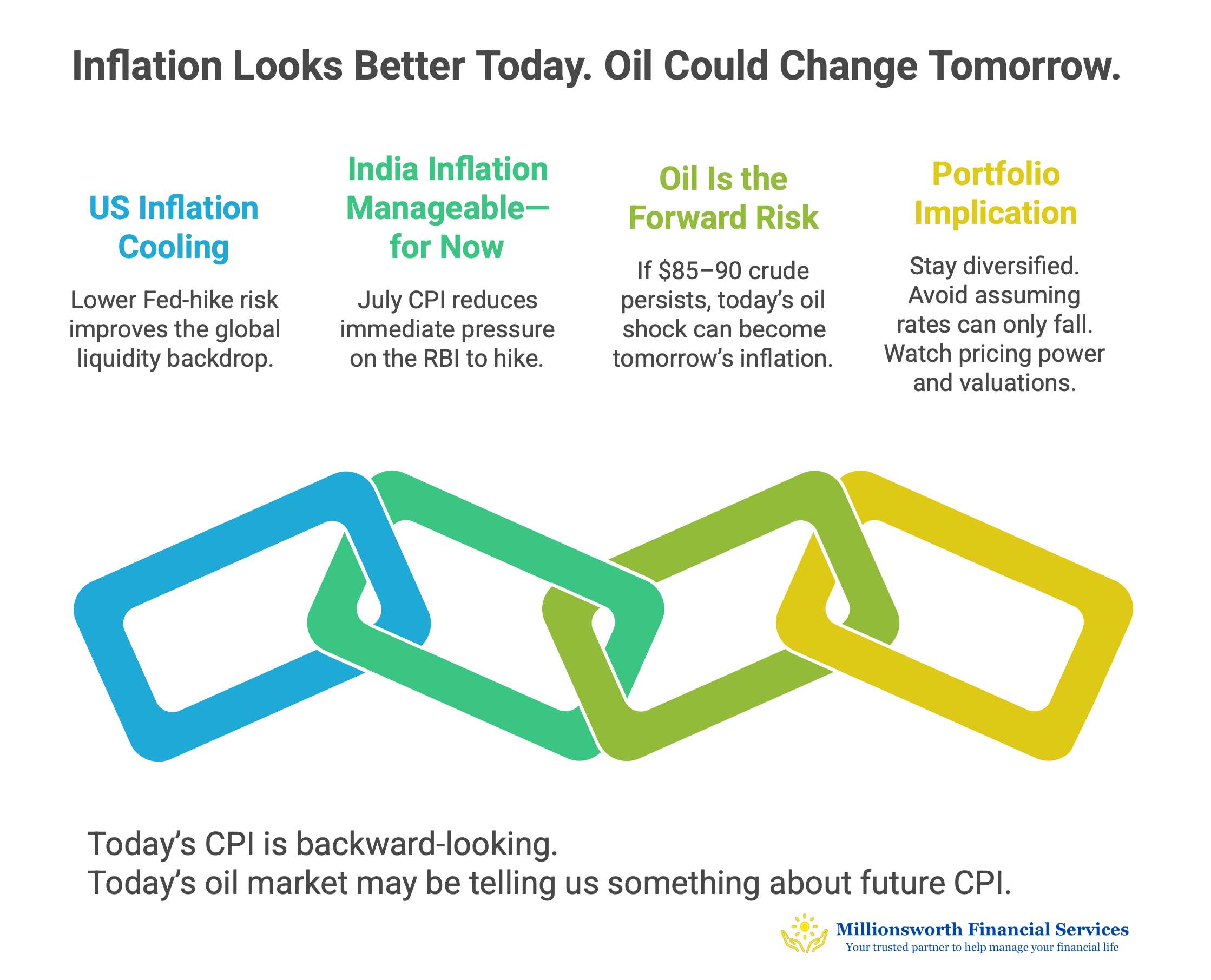
At first glance, the latest inflation data looks reassuring. US inflation has cooled, while India’s July CPI remains manageable. That has reduced some of the immediate pressure on both the Federal Reserve and the RBI.
But crude oil remains close to $90 per barrel—and that could change the inflation picture in the months ahead.
The important distinction is this:
Today’s CPI tells us largely about yesterday’s economy.
Today’s oil market may be telling us something about tomorrow’s inflation.
For investors, understanding that difference is more useful than reacting to any single inflation number.
Why the latest inflation numbers are reassuring—but incomplete
US consumer inflation moderated in July, reducing some of the market’s concern about another immediate Federal Reserve rate increase.
That matters beyond the US.
When expectations of higher US interest rates decline, pressure on US bond yields and the Dollar can ease. This can improve the relative attractiveness of emerging markets and potentially support capital flows into countries such as India.
India’s July CPI also remained relatively manageable at 4.45%. More importantly, underlying inflation has not yet shown signs of spreading aggressively across the broader economy.
This reduces the immediate pressure on the RBI to tighten monetary policy further.
So far, so good.
But inflation data is backward-looking.
July CPI measures prices that prevailed during July. If crude oil has risen sharply only recently, the full impact of that increase may still be travelling through inventories, transportation costs and corporate pricing decisions.
Why do higher crude oil prices increase inflation in India?
India imports most of the crude oil it consumes. This makes the relationship between crude oil and inflation in Indiaparticularly important.
When crude prices rise, India has to spend more Dollars to purchase roughly the same quantity of oil.
That can begin a wider economic chain:
Higher crude prices
→ Higher import bill
→ Greater demand for Dollars
→ Pressure on the Rupee
→ Higher transportation and input costs
→ Pressure on corporate margins
→ Possible price increases
→ Higher inflation
But this chain does not happen instantly.
A tyre manufacturer may still be consuming synthetic rubber purchased earlier at lower prices.
A logistics company may initially absorb higher diesel costs.
A consumer company may delay increasing prices because it does not want to lose customers.
Only when higher replacement costs persist do companies face the harder decision: absorb the cost or pass it on.
That is why today’s inflation can remain comfortable even while future cost pressure has already started building.
What has changed in the oil story?
Until recently, investors could reasonably assume that much of the rise in crude was a temporary geopolitical premium.
The logic was straightforward:
Geopolitical tension rises → oil rises.
Tension eases → oil normalises.
The latest global supply assessments make that assumption less comfortable.
The International Energy Agency now expects a meaningful gap between global oil supply and demand, while Middle Eastern production remains well below pre-conflict levels.
If part of the oil-price increase reflects an actual shortage of physical supply rather than only geopolitical fear, crude could remain elevated for longer than markets initially expected.
That does not mean investors should forecast that oil will remain at $85–90.
A more useful question is:
What happens to the portfolio if it does?
That is a stress test—not a prediction.
What could this mean for equity mutual funds?
Higher oil does not affect every business equally.
Industries such as aviation, tyres, paints, chemicals and logistics can face higher fuel or crude-linked input costs.
But the eventual impact depends on more than the commodity price itself.
One important factor is pricing power.
Can the company increase prices without materially losing customers or market share?
A business with a strong brand, differentiated product or limited competition may be better able to pass higher costs on.
A business operating in a highly competitive market may have to absorb more of the increase, putting greater pressure on profitability.
For mutual fund investors, however, this does not mean trying to forecast each company quarter by quarter.
The more relevant questions are:
- Does the fund have meaningful exposure to sectors vulnerable to higher oil?
- Does that exposure materially change the fund’s risk characteristics?
- Does the fund still perform the role for which it was selected in the overall portfolio?
That keeps the focus where it belongs: on the investor’s portfolio rather than short-term stock forecasting.
What could this mean for debt mutual funds?
The relationship is different for debt funds.
If inflation stays contained, the RBI has greater flexibility to keep policy rates stable.
But if persistent oil prices begin pushing broader inflation higher, expectations about future interest rates can change.
That matters because different debt-fund categories have different sensitivities to interest-rate movements. Funds holding longer-maturity bonds generally respond more sharply to changes in yields than shorter-maturity portfolios.
The important question is therefore not:
“When will the RBI cut rates?”
It is:
“Is the interest-rate risk in the debt portfolio appropriate for the investment horizon and purpose of the money?”
That is a more useful framework than making portfolio decisions around one policy forecast.
What should investors watch next?
Rather than following every headline independently, it may help to watch a simple sequence.
First: Crude oil
Is it remaining elevated or beginning to normalise?
Second: The Rupee
Is higher oil creating sustained currency pressure?
Third: Core inflation
Are higher food and energy costs spreading into broader goods and services?
Fourth: RBI commentary
Does the central bank continue to view the pressure as manageable, or does it become concerned about persistence?
Fifth: Corporate margins
Are companies successfully passing costs on, or beginning to absorb them?
Together, these indicators provide a much more useful picture than any single CPI number.
The portfolio takeaway
The current environment is neither clearly bullish nor clearly bearish.
US inflation has improved.
India’s inflation remains manageable for now.
But oil remains an important forward risk.
None of these developments automatically requires a portfolio change.
For mutual fund investors, the more useful question is whether the existing asset allocation, fund selection and risk exposure remain appropriate for the financial goal, investment horizon and ability to tolerate volatility.
That is why crude oil and inflation in India should be watched together, rather than treated as two separate economic stories.
Following macroeconomic developments should help investors understand risk better—not encourage them to rebuild portfolios after every headline.
Today’s CPI tells us about yesterday’s economy.
Today’s oil market may be telling us something about tomorrow’s inflation.
The objective is not to predict every RBI decision or market movement.
It is to ensure that the assumptions behind a financial plan and mutual fund portfolio remain appropriate as the economic environment evolves.
Millionsworth Financial Services
AMFI Registered Mutual Fund Distributor | ARN-171940
This article is for investor education and general information only. It does not constitute a recommendation to buy, sell or switch any security, mutual fund scheme or asset class. Mutual fund investments are subject to market risks. Please read all scheme-related documents carefully.