

Over the past few months, Specialised Investment Funds (SIFs) have generated significant market interest. Positioned strategically between traditional mutual funds and high-barrier Portfolio Management Services (PMS), they offer sophisticated flexibility and access to advanced strategies.
But a critical question remains: Should you actively allocate capital to SIFs, or are they meant only for a select group of investors?
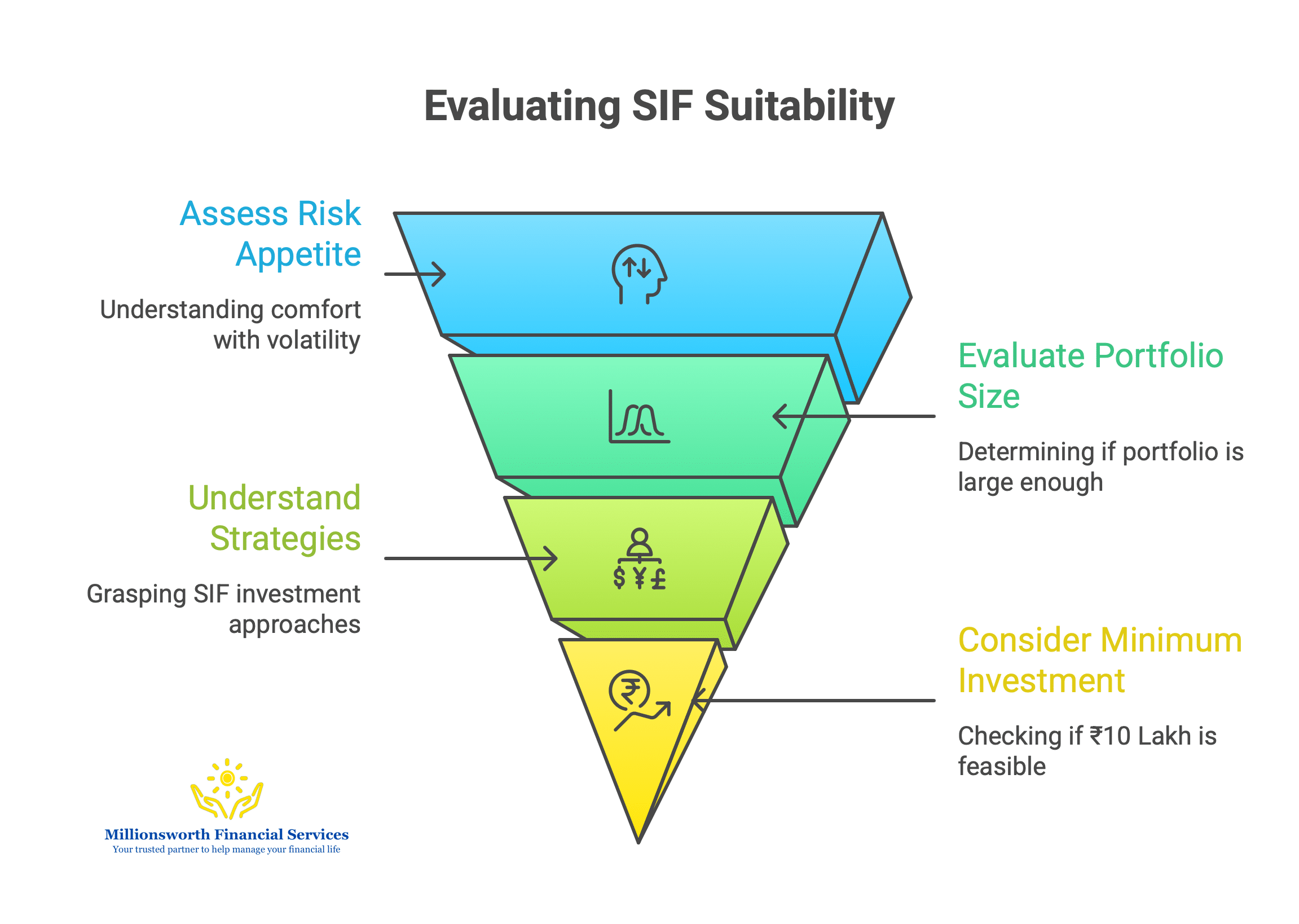
An investment product should never be selected just because it is new or trending. It must be chosen because it aligns perfectly with your financial goals, risk appetite, and the size of your existing portfolio.
What Are SIFs?
SIFs are professionally managed investment vehicles that deploy advanced tactical strategies beyond the scope of regular mutual funds. While standard mutual funds are generally “long-only,” SIFs can invest dynamically across asset classes, utilize derivative strategies, and execute specialized approaches like long-short strategies to generate returns.
They are designed exclusively for investors who:
- Have a higher risk appetite and understand the mechanics of derivatives.
- Are comfortable navigating elevated market volatility.
- Already have a well-diversified core portfolio in place.
- Are comfortable with a higher minimum investment amount.
Where Do SIFs Fit in the Wealth Hierarchy?
| Product | Minimum Investment | Best Suited For & Strategy Focus |
| Mutual Funds | Starts from ₹500 (SIP) | Beginners & long-term investors (Simple, accessible, primarily long-only). |
| SIFs | ₹10 Lakh minimum | Experienced investors (Flexible, complex, strategy-driven). |
| PMS | ₹50 Lakh minimum | High-net-worth investors (Highly customized, predominantly long-only). |
Who Should Consider SIFs?
The First-Time Salaried Investor: If you are just beginning your investment journey, SIFs are not the right starting point. Building a robust emergency fund and compounding wealth through diversified mutual funds must come first. Furthermore, from a pure diversification standpoint, allocating a massive percentage of your net worth to a single, complex strategy looks like adding significant risk.
The High-Income Investor with an Existing Portfolio: If you already have a strong portfolio and understand market risks, SIFs are an excellent addition for strategic diversification. However, mathematics must dictate your decision. Because SIFs require a ₹10 Lakh minimum commitment, that allocation should ideally not exceed 15–20% of your total investable assets. By that logic, investing in an SIF only makes sense if your total portfolio size is at least ₹50 Lakhs.
The Retired Conservative Investor: If your primary mandate is capital preservation and liquidity, the complexity and potential volatility of SIFs make them largely unsuitable. However, if your asset base is exceptionally large, allocating a strict up to 10–15% to a low-volatility SIF strategy could add a non-correlated layer of diversification to your retirement corpus.
Key Takeaways
Knowledge is Mandatory: Invest in SIFs only if you fundamentally understand the underlying strategy and its associated risks.
A Complementary Asset: SIFs should complement, not replace, your core mutual fund portfolio.
Avoid the FOMO Tax: Never invest in a vehicle simply because it is the newest product in the market.
Stick to the Foundation: Traditional mutual funds remain the most efficient starting point for the vast majority of investors.
Final Thoughts
SIFs represent a powerful evolution in Indian wealth management, but they are not a universal solution.
If you are considering adding an SIF to your portfolio, the real question is not whether the product’s past returns look attractive—it is whether it is appropriate for your specific financial situation.A well-chosen investment strategy should help you sleep better at night, not leave you wondering what you have invested in.