
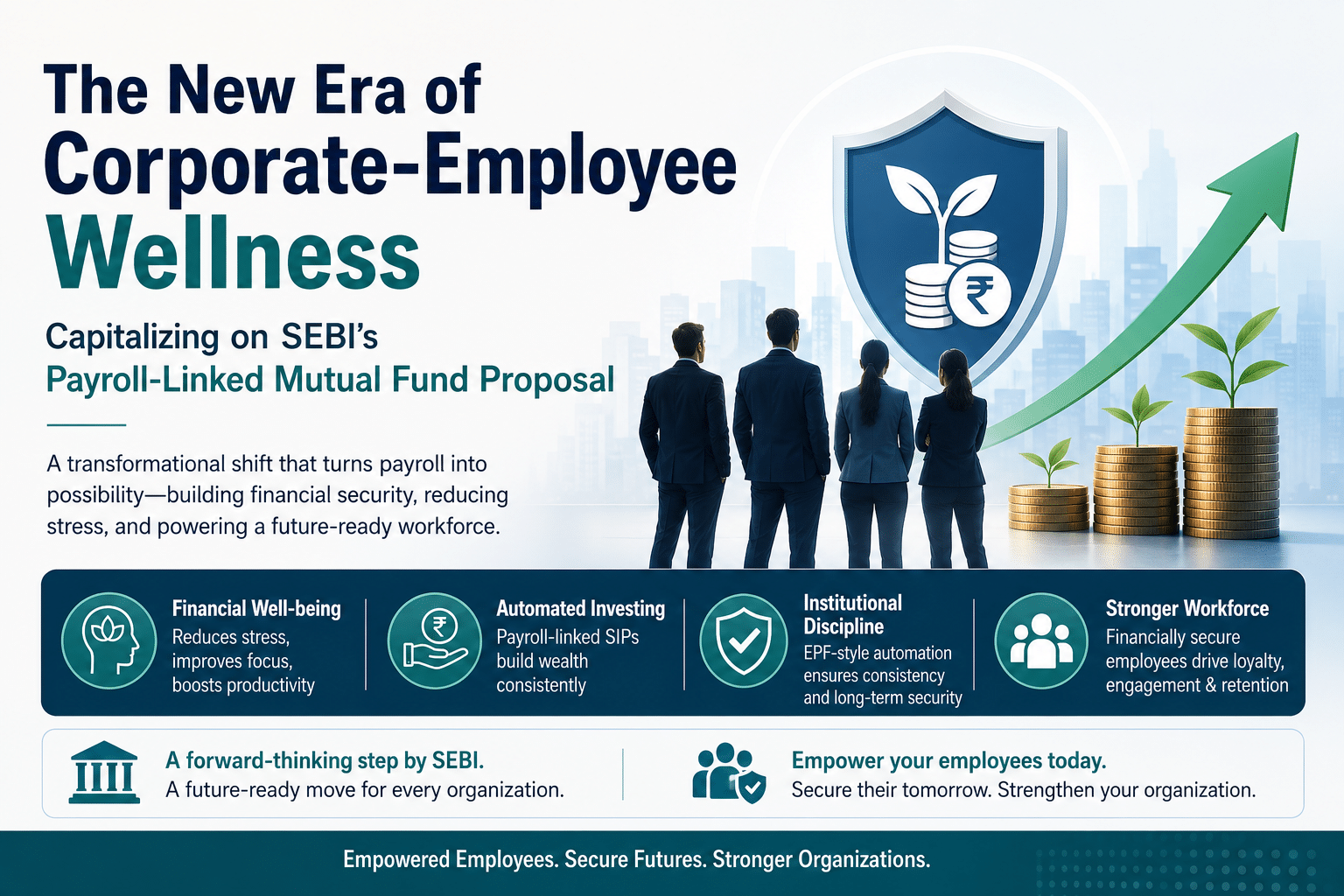
SEBI Payroll-Linked SIPs could transform corporate employee wellness in India by enabling employers to facilitate automated mutual fund investments directly through payroll deductions. As financial stress increasingly affects employee productivity, retention, and workplace focus, this proposed framework creates a major opportunity for organizations to build financially secure and future-ready workforces.
For progressive HR leaders and business owners, the mandate has expanded beyond merely managing payroll to actively optimizing it. A major regulatory shift is on the horizon that will rewrite the playbook for corporate employee benefits. The Securities and Exchange Board of India (SEBI) has recently floated a ground breaking consultation paper proposing to allow third-party payments in mutual funds for specific structural scenarios—most notably, allowing employers to make mutual fund investments on behalf of their employees directly via payroll deductions.
The Macro Shift: Moving Beyond the Traditional Safety Net
According to PGIM India Retirement Readiness Survey, a striking paradox exists within the modern Indian workforce: while roughly 67% of urban professionals believe they are “ready” for retirement, nearly two-thirds concurrently report experiencing acute financial anxiety. The underlying structural factors explain this tension:
- 12x Corpus Requirement: Corporate professionals now realize they require 10 to 12 times their annual income for a secure retirement—up drastically from the 8x estimate in 2020.
- The Rise of Alternate Income: Concern over lacking alternate income streams jumped from 8% to 38% as professionals look to hedge against market volatility.
- The Focus Drain: Employees facing acute financial stress admit to losing over half of a standard working day to personal money management or anxiety.
As family models shift from joint systems to nuclear units, the reliance on a communal safety net has faded. Employees are increasingly realizing that yesterday’s savings metrics are structurally insufficient. In response, they are quietly looking to their employers as the ultimate “anchor of stability.” In fact, the survey highlights that 1 in 2 professionals state their corporate loyalty would measurably increase if their employer actively facilitated structured retirement and long-term financial planning.
Deconstructing SEBI’s Proposal: “EPF-Style” Automation for Capital Markets
Historically, strict Anti-Money Laundering (AML) frameworks and Prevention of Money Laundering Act (PMLA) provisions strictly prohibited third-party bank payments into an individual’s mutual fund folio. An employee was forced to navigate the logistical friction of setting up individual bank mandates (ECS/NACH) from their private savings accounts post-salary credit.
SEBI’s new regulatory proposal intends to safely bridge this gap. By allowing corporate entities—specifically listed institutions and EPFO-registered organizations—to route money directly from the corporate payroll processing channel into employee-selected Mutual Fund schemes, SEBI is paving the way for “Payroll-Linked Mutual Fund SIPs.”
This operational mechanism introduces institutional discipline to wealth creation. By automating the investment flow at the source—before the net income hits the employee’s personal retail account—it leverages the exact behavioural architecture that has made the Employees’ Provident Fund (EPF) and the National Pension System (NPS) incredibly beneficial and successful.
The Strategic Behavioural Formula: The classic retail formula of Savings=Income−Expense consistently fails because human psychology treats savings as an afterthought, leading to lifestyle creep.
SEBI’s proposal enables the institutional execution of the Pay-Yourself-First Formula: Discretionary Spending=Total Income−(Automated Investments+Fixed Obligations).
The Selection Minefield: Why Accessibility Demands Accountability
While this pending regulatory shift dramatically lowers the barrier to entry, it simultaneously exposes corporate workforces to a strategic risk: Financial Noise.
We live in an era where employees are continuously bombarded by unverified financial advice, algorithmic “fin-fluencer” content, and speculative social media trends. Without an institutional-grade filter, the convenience of a direct payroll deduction link could inadvertently cause employees to channel capital into highly volatile, inappropriate, or cyclical asset classes.
Unregulated advice often transitions into vulnerability toward predatory financial schemes, leading to catastrophic capital losses. When an employee suffers a personal financial crisis, the resulting distraction inevitably manifests within the office walls as absenteeism, low engagement, and operational errors. Ease of access must be paired with institutional accountability.
The Millionsworth Solution: A Dual-Engine Framework for HR Leaders
At Millionsworth Financial Services, we collaborate with corporate organizations to construct comprehensive, institutional-grade Financial Well-being Programs that turn these regulatory shifts into immediate competitive advantages. Our framework operates across two distinct strategic pillars:
1. Holistic, Shielded Financial Planning
We act as a professional, fiduciary filter between your employees and the noise of the retail financial market. Our team of certified professionals ensures that before any automated payroll deduction goes live, your employees have access to customized, goal-based planning architectures. We help them establish smart personal budgeting frameworks to cleanly segregate fixed living expenses from lifestyle choices. By mapping out their individual “Financial Graphs,” we safely align their optimized budgeting buckets directly with automated payroll-linked mutual fund flows to achieve tangible life milestones—such as asset building, children’s higher education, and inflation-adjusted retirement.
2. Zero-Outlay Salary Restructuring & Tax Optimization
We ensure that the corporate payroll framework is engineered to work as hard as possible for your workforce. Through expert salary component restructuring, we eliminate systemic tax inefficiencies. By optimizing allowances, perquisites, and flexible benefit structures under current tax statutes, we safely increase your employees’ effective take-home pay.
The Enterprise Impact: Your organization successfully delivers a meaningful net compensation “raise” to the workforce without expanding the company’s fiscal budget or altering the baseline Cost-to-Company (CTC) metrics. This newly recovered, tax-optimized surplus can then be directly channelled into the upcoming payroll-linked mutual fund SIPs, maximizing compounding returns.
The Enterprise Return on Investment (ROI)
Investing in a robust financial wellness framework is a highly quantifiable business strategy. Forward-thinking enterprises realize returns across three key vectors:
Recovered Cognitive Capacity: Minimizing personal financial anxieties directly restores focused working hours, driving higher daily operational output and reduced project execution friction.
Asymmetrical Retention Advantage: Facilitating high-impact financial planning and structural tax relief establishes deep institutional goodwill, making your company highly resilient against talent poaching.
Optimized Capital Efficiency: You ensure that the gross salary allocations you distribute are fully maximized, ensuring your payroll spend creates the highest possible level of employee financial security.
Prepare Your Organization for the Future of Benefits
The regulatory landscape is moving rapidly, and the firms that position themselves as early adopters of financial well-being frameworks will capture the highest tier of talent market share.
Let us help you audit your existing payroll structures, eliminate tax drag, and design a robust, compliant financial advisory framework for your workforce. Contact us today to schedule a strategic, 60-minute introductory consultation.