India’s growth outlook is improving even as interest rates rise. Here is why the two can coexist—and what the changing environment means for equity investors, fixed-income investors and borrowers.
At first glance, India’s economic picture appears contradictory.
Business activity improved in September. The World Bank has upgraded India’s FY27 growth forecast. The government has announced fresh capital support for small and medium enterprises.
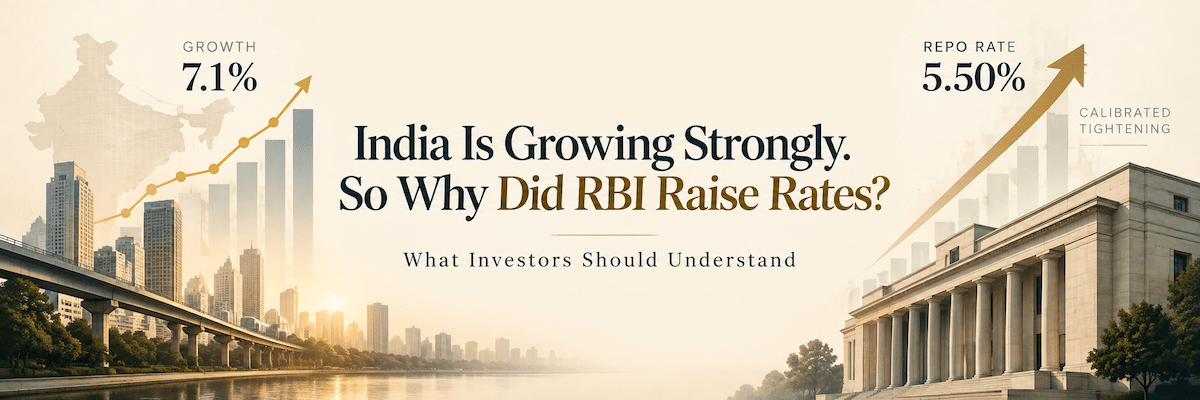
And yet, the Reserve Bank of India has raised the repo rate by 25 basis points to 5.50% and shifted its policy stance from “neutral” to “calibrated tightening.” RBI has also raised its FY27 growth projection to 7.1%, while increasing its inflation projection to 5.2%.
So, if the economy is doing reasonably well, why is monetary policy becoming tighter?
The answer is important for investors.
Strong growth and tighter monetary policy are not contradictory.
In fact, resilient growth reduces the immediate trade-off between supporting economic activity and controlling inflation. That gives RBI greater room to respond to price pressures without immediately worrying about significantly weakening economic activity.
The RBI stance change may matter more than the 25-bps hike
The rate increase itself was largely anticipated.
The more important signal is RBI’s change in stance from neutral to calibrated tightening.
RBI has raised its FY27 inflation projection from 5.0% to 5.2%, while simultaneously increasing its GDP growth forecast from 6.7% to 7.1%.
That combination tells us something important.
RBI is not tightening because the economy is collapsing. It is tightening while growth remains relatively resilient because inflation risks have become more persistent and broader.
That changes the question for investors.
Instead of asking whether one 25-basis-point hike will materially change the economy, the more relevant question is whether this marks the beginning of a gradual tightening phase—and how far policy eventually needs to move before inflation pressures become more comfortable.
RBI has kept future decisions dependent on incoming inflation and growth data, so the path from here is not predetermined.
Is the economy really as strong as the headlines suggest?
There is evidence of resilience.
The HSBC India Services PMI increased to 55.2 in September from 54.1 in August, while the Composite PMI rose to 55.9 from 54.3. Readings above 50 indicate expansion, and September benefited from stronger domestic demand and new orders.
But one month should not be viewed in isolation.
Despite September’s improvement, average services and composite activity during the July–September quarter was weaker than in several preceding quarters. Employment growth moderated and export-order momentum also softened.
So the correct interpretation is not that economic activity is accelerating uninterruptedly.
It is that India continues to expand at a healthy pace, while the underlying data still requires careful reading beyond a single monthly number.
The World Bank’s latest assessment reinforces that broader picture. It has raised India’s FY27 growth forecast to 7.1% from 6.6%, supported by domestic demand, industrial and services activity and stronger-than-expected economic performance.
At the same time, risks have not disappeared. Oil prices, international financial conditions and capital-flow volatility can still affect India’s inflation, currency and broader financial environment.
Domestic resilience provides a cushion. It does not eliminate external risk.
Another useful development is the Union Cabinet’s approval of a ₹10,000 crore commitment to the SME Growth Fund, intended to improve access to growth-oriented capital for viable small and medium enterprises.
That highlights an important distinction.
Monetary policy can tighten while targeted policies continue to support productive investment and business growth.
A higher repo rate influences economy-wide financial conditions. A targeted SME fund attempts to address a structural problem—access to long-term growth capital.
So the economic story cannot be reduced to a simple equation of:
Rates up = growth down.
So what does all this mean for your money?
This is where the macroeconomic discussion becomes more relevant to individual financial decisions.
For equity investors: Does strong growth automatically mean strong stock returns?
Not necessarily.
Healthy economic growth can support business activity, revenues and, over time, corporate earnings.
But higher interest rates also increase the cost of capital. That can affect borrowing costs, investment decisions and valuations—particularly for businesses where a large part of the market value depends on profits expected far into the future.
Rate-sensitive sectors may also experience greater pressure.
The distinction investors need to make is between the economy and the price being paid for exposure to that economy.
Strong GDP growth does not automatically mean every equity valuation is attractive.
Growth tells us something about business conditions. Valuation tells us how much optimism may already be reflected in market prices.
The appropriate equity allocation therefore still depends on the investor’s time horizon, financial capacity and ability to live through market drawdowns—not simply on whether the economic outlook appears positive.
Watch: How Much Risk Is Actually Worth Taking?
A discussion on the relationship between risk, patience and portfolio allocation.
For fixed-income investors: Are rising rates necessarily bad?
The answer is more nuanced.
When yields rise, existing longer-duration bonds can experience price pressure because bond prices and yields generally move in opposite directions.
But the same increase in yields can improve the starting yield available on fresh fixed-income investments, potentially improving prospective returns for investors who can hold those investments for an appropriate period.
So rising rates can create both repricing risk and future opportunity.
Which matters more depends on the investor’s time horizon and the role that fixed income is supposed to play in the portfolio.
Debt investments may be there to provide liquidity, stability or to fund a financial goal at a known point in time. In those situations, simply chasing the highest available yield may not be the right objective.
Duration and credit risk should be matched to the job that the money needs to perform.
For borrowers: What happens to your loan?
Borrowers with loans linked to floating benchmarks should prepare for the possibility of higher borrowing costs as monetary-policy transmission moves through lenders.
Depending on the loan structure, that could appear as a higher EMI, a longer repayment tenure or some combination of the two.
The important question, however, is not simply:
Should I prepay my loan?
A better financial-planning question is:
If borrowing costs rise, how much additional debt servicing can my household cash flow absorb before other financial priorities begin to suffer?
An aggressive loan prepayment may reduce interest costs, but it may also consume liquidity or money that was intended for another important goal.
The decision therefore needs to be made in the context of the overall financial plan.
A useful market reminder: expectations matter
Tuesday’s market movement provides a useful illustration.
The Sensex and Nifty rose close to 1% ahead of the RBI decision even though a rate increase was widely anticipated. After the announcement, the broader market reaction was more mixed.
That is not necessarily contradictory.
Markets do not react simply to whether a development sounds positive or negative. They react to what investors were already expecting, what was already reflected in prices and what new information changes those expectations.
This is an important behavioural lesson.
A macroeconomic headline is information. It is not automatically an investment instruction.
Trying to convert every RBI decision, inflation number or GDP forecast into an immediate portfolio action can create more activity without necessarily improving the financial outcome.
Don’t build a portfolio that requires one macro prediction to be right
Today, several different narratives can sound equally convincing.
Strong growth may support equities. Higher rates may improve future fixed-income opportunities. Inflation may remain persistent. Oil prices may rise or fall. Global financial conditions may become easier—or more difficult.
The problem is not that one of these views must be wrong.
The problem arises when a portfolio is constructed in such a way that only one particular view can be right for the financial plan to succeed.
That is one of the fundamental reasons diversification matters.
Diversification is not an admission that we have no view about markets.
It is an acknowledgement that several plausible outcomes can exist at the same time—and investors rarely know in advance which one will dominate.
Watch: Why Diversification Matters Even When You Have a Strong Market View
And the portfolio is still only one part of the financial system
Even if an investor gets asset allocation broadly right, the job is not finished.
A household can have a well-performing portfolio and still remain financially vulnerable because of inadequate liquidity, excessive debt, insufficient insurance, poorly timed goals or excessive dependence on one income source.
That is why portfolio management and financial planning should not be treated as the same thing.
Investments are an important tool. But they operate within a wider financial system.
Watch: Why a Good Portfolio Can Still Fail Your Financial Life
The bigger takeaway
India currently presents an interesting combination: resilient domestic growth, improving activity indicators and a central bank becoming more cautious about inflation.
For investors, the appropriate response does not necessarily require predicting the next RBI move, the next Nifty level or the exact direction of bond yields.
More useful questions are whether your portfolio risk matches your financial capacity, whether you are diversified across different possible economic outcomes, whether your debt remains manageable if borrowing costs rise, and whether your broader financial plan remains resilient if markets behave differently from what you expect.
Strong economies can still produce volatile markets. Good financial planning prepares for both.
This article is for educational purposes only and does not constitute investment advice or a recommendation to buy or sell any security or investment product. Mutual Fund investments are subject to market risks. Read all scheme-related documents carefully.
Millionsworth Financial Services
AMFI Registered Mutual Fund Distributor | ARN-171940